There has always been a divide between those in the know, the so-called Smart Money, and the crowd on the outside looking in, who aren’t privy to market-moving information.
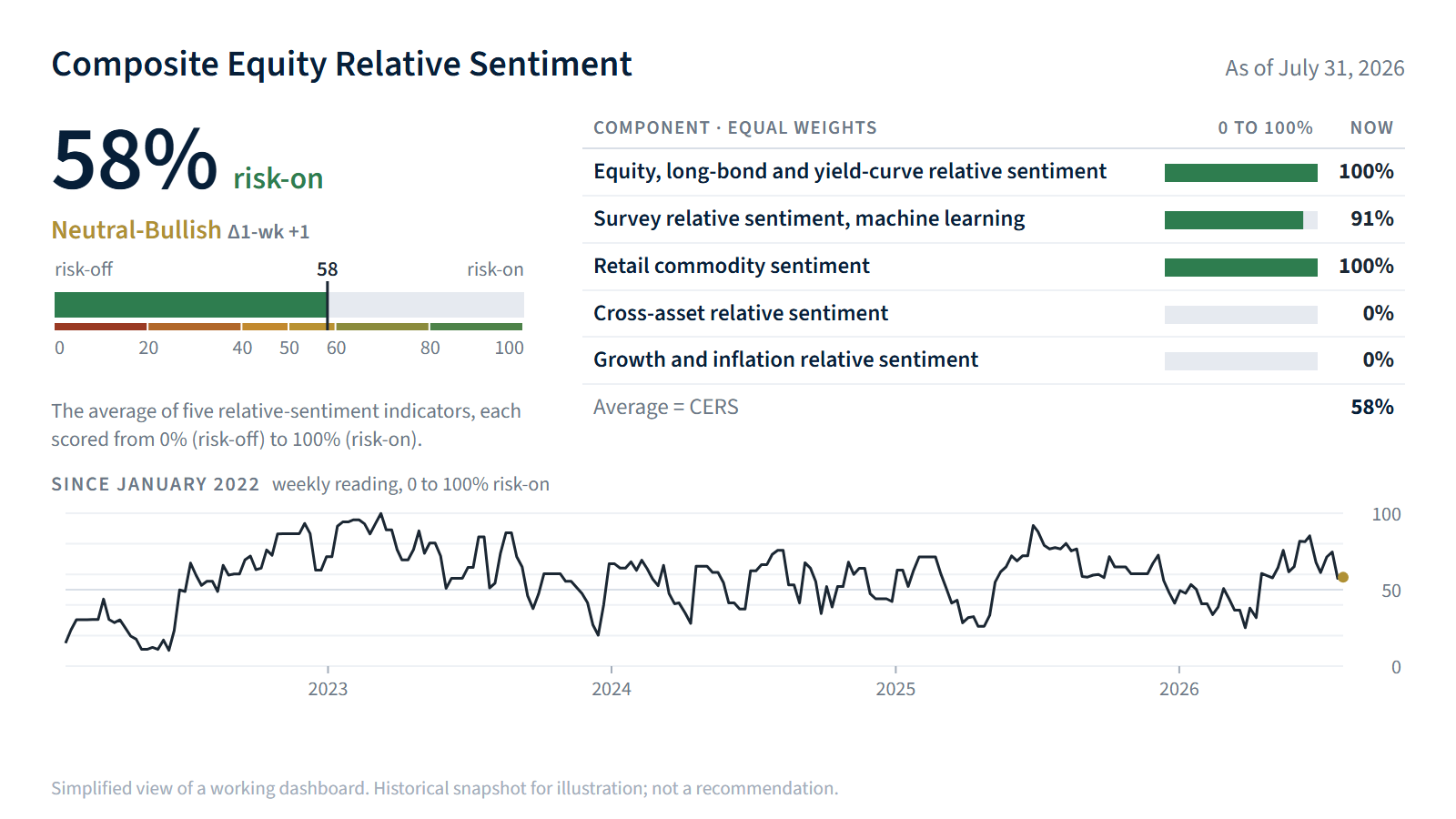
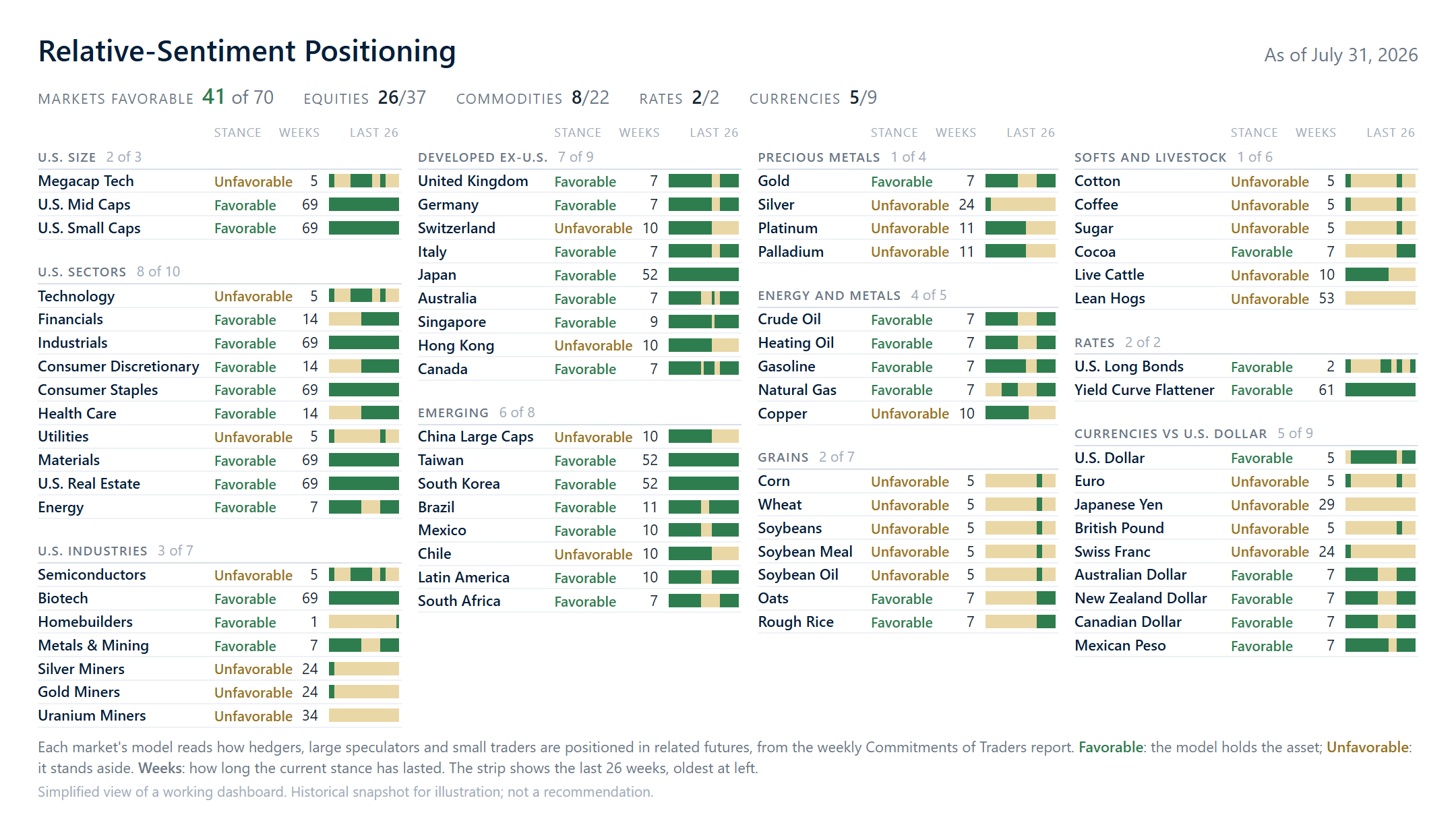
Relative sentiment reads the footprints the Smart Money leaves in its positioning, a trail that hints at the path ahead for asset prices.
Pensions, endowments, insurers, large asset managers and investment banks on one side; a broader crowd that chases strength and sells weakness on the other. At extremes the two are usually on opposite sides, and on balance the better-resourced, better-informed side has been the one worth following. Relative sentiment measures that divide directly. Sentiment that everyone shares carries little information; the useful signal comes from the difference between the two groups.
There is an intuitive reason relative sentiment should work. Institutions have structural advantages the crowd doesn’t: better information networks, deeper pools of human capital, and a hand in shaping the narratives everyone else reacts to. The question is whether that edge holds up to scrutiny. Measured against one widely cited set of criteria for a genuine factor, we believe it does:
The idea of the Smart Money is as old as markets themselves. The evidence for it has held up out of sample, including in independent replications extending the work to the present.
Vetted, replicated and debated in top academic journals, including 18 papers in the top three finance journals between 1999 and 2015.
Documented across dozens of countries and regions, and across asset classes beyond U.S. equities.
Has held up under changes to how the signal is constructed, and across different data sets and time periods.
There’s a credible reason for it to continue: institutions’ structural advantages, and the crowd’s habit of chasing strength and selling weakness.
t-statistics strong enough to clear the stricter thresholds needed to account for data-snooping.
Relative sentiment is a tendency, not a rule; no factor is guaranteed to persist. Evidence above draws on published academic and practitioner research, linked throughout.
Your outsourced investment committee: weekly market calls, in-depth macro reviews, white-labeled reports, positioning guidance across asset classes, and full access to our analytical engine, plus a secular real-assets view held since 2022.
Explore advisory →Our relative-sentiment approach in one tax-efficient ETF. It lets you stay tactical across markets without the tax friction that doing it yourself might otherwise trigger. Live since 2022.
See the fund →Our weekly view of the market landscape and where positioning stands, delivered to your inbox.
Subscribe →The dashboards we use to monitor relative sentiment and positioning, each with its full history and the reasoning behind it. Our outsourced-CIO clients see the same dashboards we do.
Our ETF allocates dynamically across global equities, bonds, precious metals, commodities, energy, and the dollar based on relative sentiment, rebalancing when its target allocations shift materially. As an ETF, its tactical adjustments stay inside a tax-efficient wrapper, sparing you the tax friction your own adjustments might otherwise trigger. Live since 2022.
Our weekly view of the markets and where positioning stands, delivered to your inbox.
Caution: you are now leaving the advisor area and entering the ETF funds area. The following link contains information concerning investments, products or other information that is distributed by PINE Distributors LLC, Distributor. This information is not an offer to buy or a solicitation to sell any security or investment product. Such an offer or solicitation is made only by the securities’ or investment products’ issuer or sponsor through a prospectus or other offering documentation. Investments involve risk. Principal loss is possible.